
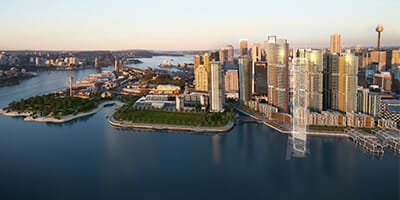

Pension funds are major backers of the $6-billion Barangaroo South office towers being constructed in central Sydney by property developer Lend Lease.
Canada’s largest pension fund, the $161.6-billion Canada Pension Plan Investment Board (CPPIB), invested $1 billion in the development. Australian funds First State Super and Telstra Super together committed $250 million to the Australian Prime Property Fund Commercial (APPF), a vehicle run by Lend Lease’s fund-management arm that backed the deal. The APPF injected a further $250 million and Lend Lease itself gave $500 million.
Barangaroo South’s 41- and 38-storey towers will front Sydney’s Darling Harbour in the city centre. Westpac, one of Australia’s four largest banks, has committed to renting 70 per cent of one tower. Lend Lease and corporate services firm KPMG will occupy 75 per cent of the second tower upon completion in 2015. Talks of a third tower are underway.
“It’s a new development in a precinct that the business community is focusing on,” Michael Dwyer, chief executive officer of First State Super, the $32-billion Sydney-based fund, says. “We’ll wait and see how plans for the third tower develop.”
Expanding property portfolios
Barangaroo South is CPPIB’s largest single asset in its $16.4-billion portfolio of property assets, of which $1.63 billion is invested in Australia. The deal marks the first time the fund has invested directly in real estate instead of through a fund managed by a third party.
First State Super’s stake is part of the fund’s $1.92-billion property portfolio. Telstra Super, which manages $11.5 billion in retirement savings for employees of Australia’s largest telecommunications company, owns $1.5 billion in property assets. The super funds were already clients of Lend Lease’s $11.8-billion fund-management arm before the Barangaroo deal.







Leave a Comment
You must be logged in to post a comment.