
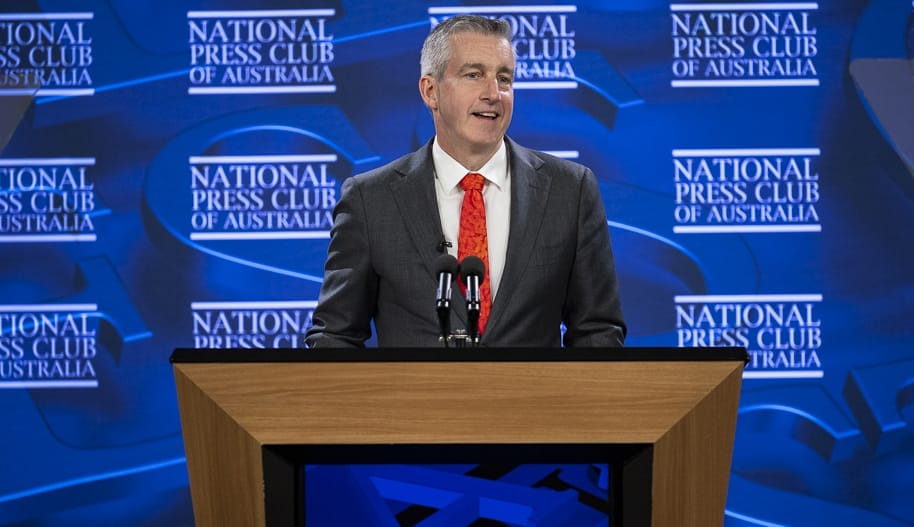

Paul Schroder, the chief executive of the $400 billion AustralianSuper, has used a national soapbox to push for industry reforms including on financial advice laws, a ‘build to sell’ housing investment model and the Your Future Your Super performance test.
In a televised National Press Club address – understood to be the first ever offered to a sitting super fund CEO – Schroder said legislative and regulatory reforms were required for the super system to transform member experience.
“Millions of Australians are approaching retirement, and they’re doing so with higher balances, longer life expectancies, and more diverse retirement paths than ever before,” Schroder told the event in Canberra, attended by Investment Magazine.
“But the system hasn’t kept up. It’s too complex and difficult to navigate. Less than half of Australians feel confident about retirement. The system should be about simplicity and dignity.”
Schroder said that the government should focus on “streamlining” the system to let members contribute and withdraw from the same account in retirement – the “account for life” that AustralianSuper has previously proposed – and to allow the secure sharing of relevant government data with super funds to help them give members “the full picture of their retirement incomes”.
“This will allow funds to give simple, easy and tailored guidance to members when they need it most,” he said.
“I would urge you to not underestimate the need for, and the power of, simple, easy and tailored guidance and advice. There are too many Australians uncertain about their futures because we haven’t collectively resolved this complex issue.”
“[These reforms] would make a meaningful difference to the two-and-a-half million Australians about to retire. They would give members flexibility and, importantly, more confidence… We have a world-class savings system. We need to build a world-class spending system.”
Major moment
The speech marked a major moment for Australian superannuation funds, which now wield significant and increasing economic power in their home country and are making major inroads in global markets as both investors and employers.
Industry luminaries in attendance at the lunch included AustralianSuper chair Don Russell and chief investment officer Mark Delaney; Cbus chair and former federal treasurer Wayne Swan; IFM Investors chair Cath Bowtell; CareSuper chair Linda Scott; and the CEOs of ASFA, Super Members Council and super service providers including BlackRock Australia and TAL.
Schroder, a former union boss, defended the dominant but controversial “equal representation” model of trade union and employer board directorship, saying it was part of the “secret sauce” of a system he described as globally unique, likening it to Australian rules football.
“Australian superannuation is unique. It’s an Australian invention, like Australian rules football,” he said. “We didn’t invent retirement, of course, but no one else plays football or does retirement like we do.”
The speech comes as the sector faces mounting regulatory and public scrutiny, with multiple lawsuits brought by ASIC against funds including AustralianSuper for alleged insurance claims handling and member experience deficiencies.
The super system’s role in backstopping the domestic economy during times of crisis is also being re-examined as the Albanese Government looks to enhance productivity against a more volatile macro backdrop.
“This may be slightly controversial, but I think the reform agenda and the need is probably greater than the reform need of the 1980s and the 90s,” Schroder said.
“It may be more like post-World War II, 1940s and 1950s. It’ll need to be bold, it’ll need to be co-ordinated, and it’ll need to be long-term.
“Because all of the challenges we face – housing, health, the energy transition, the implications of AI and quantum computing – are massive, and they’re intersected, and those reforms, almost all of them, are physical. And we can see they’re politically charged, and we can see they’re charged locally and nationally and in communities, and they’re full of ethical dilemmas.”
Multiple decades, billions of dollars
Schroder said that it was important “not to shy away” from those dilemmas and that many of the reforms will require multiple decades and billions of dollars to implement – but while superannuation can “contribute to the national renewal” and its potential remains “unrealised”, the government should not tell funds what to invest in.
“We must break the piggybank mentality. Super is not a trillion-dollar fix-all. It cannot – and should not – be used to solve every complex national problem,” he said.
“As a nation, we can’t just keep referring every difficult issue to the ACCC, put it in the national curriculum, or get super to pay for it. That misses the point… and I reject that school of thought. It’s not smart policy thinking. We need governments and industry – including super – to do better. Much better.”
Schroder instead proposed a “build-to-sell” model where the government takes on the development risk for new assets before selling or leasing them to long-term holders like super funds.
“We must recognise the difference between the national interest and the interests of organisations and individuals,” Schroder said.
“Part of government’s role is to build things that are important for Australia, but which don’t necessarily make the kind of financial return super funds need.
“Super funds think long-term, but our returns must be real. And I mean real versus nominal. Our default investment option – where most AustralianSuper members are invested– targets CPI plus four per cent. That’s a benchmark designed to grow members’ savings ahead of inflation.”
And with Treasury now considering changes to the Your Future Your Super performance test to remove barriers to long-term investment, Schroder said that it was “utterly important” that the test not be removed completely.
“It’s really important to protect members’ interests and for members to have confidence that the fund remains performing well, because investment performance is the key driver of having a bigger balance and a better life in retirement.
“(But) the current performance test doesn’t really take account of strategic asset allocation… and there are better ways to do the performance test which would give members a more useful sense of performance. There should be a performance test, and we’re open to improving it, and it really should be ‘did your fund make you money or not?’”.






Leave a Comment
You must be logged in to post a comment.