
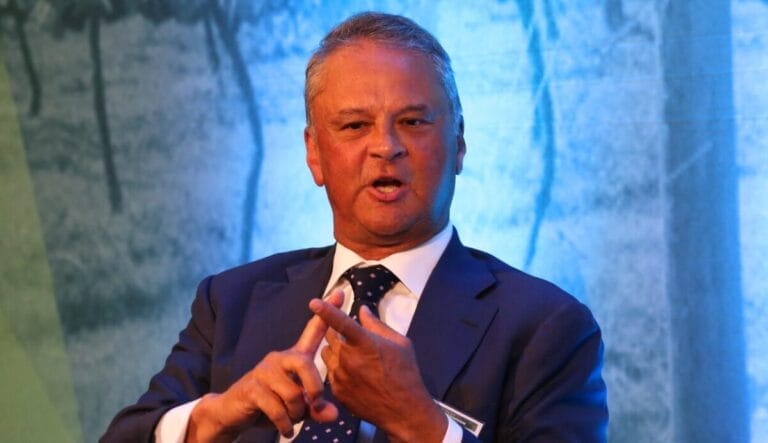

UniSuper chief investment officer John Pearce has no problem pulling mandates from an external manager if a trusted portfolio manager departs, saying the fund does not shy away from key person risks because a manager’s edge often hinges on its star players.
In a wide-range fireside chat at the Investment Magazine Fiduciary Investors Symposium, Pearce said the $160 billion fund is happy to “play the person rather than playing the ball” when it comes to manager selection in a reflection of its talent-driven approach.
“If the key person leaves, we take our money back. What’s the problem? We’re running separately managed mandates – if we tell our custodian, we can get the money back in a day,” he told the symposium in Healesville, Victoria.
“If you find a team without a key person, it’s probably an ordinary team.”
For Pearce, individuals’ reputation comes before institutions. He acknowledged that some of the fund’s best external portfolio managers have been under pressure over the short-term but that UniSuper focuses on their long-term, 10-year results, which have been “terrific”.
Around 30 per cent, or $45 billion, of UniSuper’s asset are externally managed and that share varies between asset classes (higher in Australian equities and lower in fixed income and cash). The fund is a big believer in internalising investment strategies but only when it is convinced that it can do at least as good of a job as an external manager.
It is why the fund scrutinises the thesis and performance of in-house investments closely and has so far terminated more than 10 strategies, including a “tough” US quant play – an area where even the best and the brightest in global funds management struggles to outperform.
“We’ve got a specialised mandate in tech, and we’ve got Asian mandates. I’m kidding myself if I think I could hire people in Bourke Street, Melbourne to run those better than the specialist tech manager and specialist Asian managers,” Pearce said.
“We’ve been very honest with each other [internally] to say ‘look, we can’t do it at the same price’. Even if I went on a hiring spree and set up an office in London, I still don’t think I can get the quality of people that we can get for a reasonable price [with external managers].”
UniSuper is the nation’s fourth largest super fund, but Pearce does not want to be pulled into the sector’s relentless chase for AUM. He conceded that bigger fund size is definitely an advantage in unlisted markets, giving greater bargaining power over price, structure and governance rights and access to attractive deals, but in listed markets “net-net, it has to be a slight negative”.
“You just haven’t got the manoeuvrability [in investment],” he said. “When it comes to what the goal is, to me, net inflow is much more important than size. Managing a fund in net inflow is so much easier than managing a fund in net outflow.”
UniSuper has a 3.2 per cent net flow, which consists of 1.7 per cent ‘natural flows’ (contribution less benefit payment) and 1.5 ‘competitive flows’ (rollover capital from member switching), according to the Conexus Institute* State of Super 2025 study. However, it is a modest rate compared to funds with younger members such as Hostplus and Rest, which achieved 6.1 per cent and 5.5 per cent net flow respectively.
“If we’re going to acquire another fund now, I’d rather acquire a $20 billion fund in net inflow than a $50 billion fund in net outflow,” Pearce said.
Despite leading UniSuper’s investments since 2009, Pearce has no plans to leave the post any time soon, echoing J.P. Morgan’s Jamie Dimon in saying he’ll stay “until the day I lose my intensity”.
Self-described as “very much a captain and probably not a great coach”, Pearce sees himself as leading the 75-person investment team by example, investing a portion of the portfolio himself.
“I keep things really simple – I think we can look at leadership and overcomplicate things,” he said.
“Tell people where we’re going, the role that they’ve got to play, and let them know how they’re doing, that’s 80 per cent of it. The rest is being decisive and making calls because people look up to decisive leadership.”
Pearce was tight-lipped on the details of succession planning,but highlighted a recent change in the investment team, which saw Australian equities and global equities consolidated under Penny Heard, now head of equities.
“Penny’s got global and Aussie experience: large fund, boutique, sell side, buy side. She’s a real all-rounder,” Pearce said.
“It’s not to say that she’s assuming a successor, but I think she’d be really well qualified if I got run over by a bus.”
*The Conexus Institute is a not-for-profit think tank philanthropically funded by Conexus Financial
Be part of the conversation next year – register now for the Fiduciary Investors Symposium 2026:
12 – 14 May 2026 | Blue Mountains, NSW
13-15 October 2026 | Healesville, VIC







Leave a Comment
You must be logged in to post a comment.