


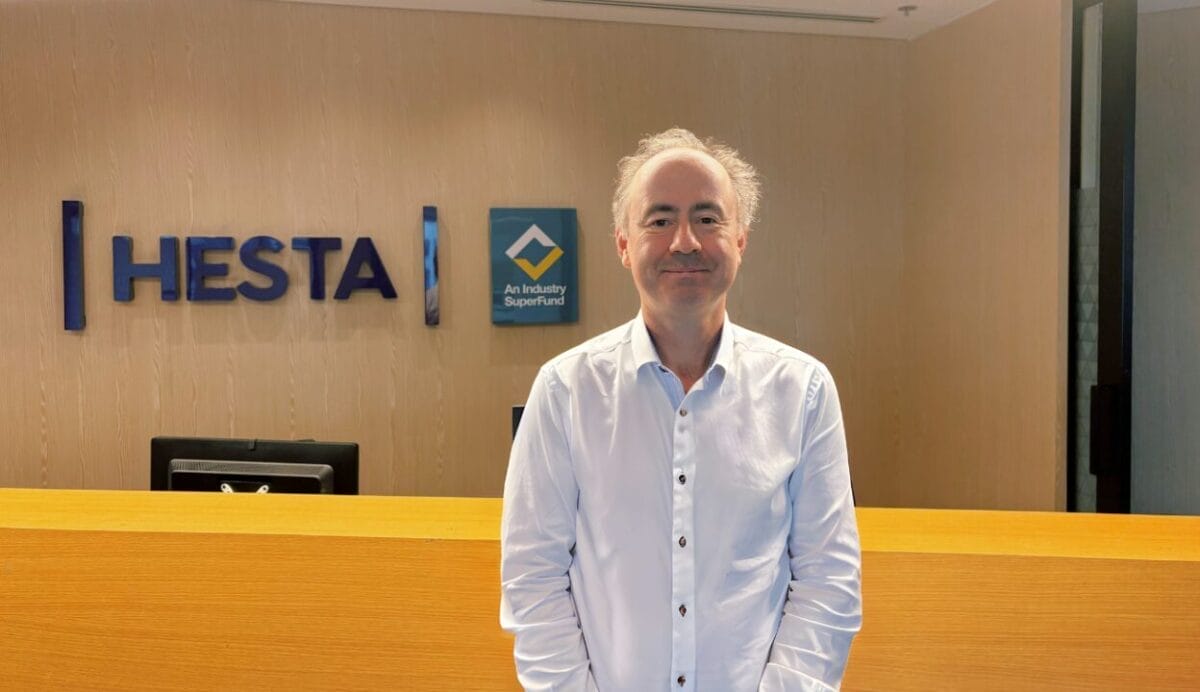
Colonial First State chief investment officer Jonathan Armitage thinks it’s time for investors to get real on return expectations.
“We’ve had three very good years of returns for super funds, and I think we’ll be moving back to more normal levels,” Armitage tells Investment Magazine in an interview in late 2025.
It’s a common refrain from CIOs that have grown sceptical of the US market’s capacity to keep powering returns higher when tech stock valuations look so stretched. But could this time actually be different? After all, valuations in developed markets look elevated, to say the least.
Armitage also expects inflationary pressures will become a bigger feature of markets, and that bond investors will start asking tough questions about budget deficits and what governments are going to do about them.
“It’s not just a US problem,” Armitage says. “There’s probably half a dozen countries in Europe, starting with France, where exactly the same sort of narrative is playing out and at the moment. T there appear to be very few concrete policy ideas about how to address that.
“And I think those two things together will serve as a sort of cap on returns. It doesn’t mean you won’t see positive returns – I just don’t think that they’ll be as aggressive.”
To that end, the CFS investment team has been building up the fund’s exposure to the un-loved and under-bought emerging markets.
“If we had this conversation 12 months ago, you would’ve laughed me out of the room if I said China would be the best-performing market [in 2025]. The strength of China in particular but also Asian markets as a whole probably caught people off guard.”
CFS’ move to allocate more to emerging markets was based on the significant valuation discrepancy between them and the developed markets – the largest, in Armitage’s assessment, since the Asian Financial Crisis.
“For us, it was an opportunity for diversification, but earnings streams were also being very differently valued. And there is absolutely no way we could have forecast this, but the launch of DeepSeek and the realisation that China was able to produce processing capability that – optically – seemed to match what was going on in the US for vastly different capex kicked off a bit of re-think of the way that the market was valuing those earnings streams.”
“That was focused on tech initially, but I think everyone then just started dusting off a whole lot of numbers around all sorts of different companies.”
As part of its larger allocation to EM, CFS consolidated some of the managers it was using and deployed capital into a mix of active and systematic strategies to capture “some of the factors that were being mis-valued by the market”.
“Value as a factor is a very strong driver of returns in emerging markets, and that probably runs contrary to the narrative. When I started my career, emerging markets were all about growth, but those strategies have been very challenged over the last decade or so.
“I think some investors who may have had exposure to emerging markets have been almost doubly disappointed, because not only have absolute returns been weak, they may have chosen managers which were very focused on growth companies.”
Armitage undertook a trip to China in late 2025 and saw a number of industrial and technology companies at a “very high level”. In his view, companies there now believe that competing on price alone will no longer be helpful for growing market share with an increasingly demanding customer base, both domestically and within Asia.
“Price is still an important component to these companies’ value proposition but it is now being backed up by proper service capabilities,” Armitage said.
“There’s one company we saw that makes production line equipment; they have a service commitment to their clients that if something goes wrong they’ll have an engineer on site within two hours. That level of service commitment is something that shows how these companies have evolved, and become a lot more sophisticated.
“Nobody has doubted the technology and their ability to produce things at low cost, but a criticism has been levelled that it’s not backed up by the service proposition, and that is absolutely changing… If we see those companies really create a service proposition alongside value, that represents a significant threat to a number of Western business models.”
Building on its diversification efforts, CFS has also “taken out an insurance policy” on the US equity market. While such protection is usually fairly expensive, Armitage says the fund was able to get it at a good price.
“We built up the capability within the team to be able to make more dynamic asset allocation decisions. The important thing around that is that the pricing goes with it. You may want to do something but the pricing may not make economic sense.
“If we go back to when we put that protection on, which was probably towards the end of northern hemisphere summer, the valuations absolutely made sense to be able to do that. It was quite long-dated, which takes us into early February. We’ll continue to look at opportunities – it’s about managing the risks that we see that have probably built up over the last couple of years in the investment portfolios.”
But despite that insurance policy, Armitage thinks there is an “over focus” on whether valuations in the AI space constitute a market bubble and warned against pulling money out of the US.
“I think people were too quick to say [Liberation Day] was the end of future investment in the US,” Armitage said. “It’s still the world’s largest, deepest, most sophisticated capital market, and there are still plenty of companies to invest in to see growth, many of which will see little or no impact from tariffs.
“All investors have quite a bit of currency exposure to the US dollar and I do think it’s sensible to think about how you would manage that… But I don’t think that means we have to halve our weight to the US. We continue to find a broad breadth of opportunities in the US, both in liquid and unlisted markets.”







Leave a Comment
You must be logged in to post a comment.