
Even a big growth shock from the war in Iran would do little to disrupt super returns, according to Hostplus chief investment officer Sam Sicilia, who also says he isn’t concerned about the recent AI-driven software downturn (dubbed the “SaaSpocalypse”) despite the fund’s investments in private tech companies.
“When people talk about a sub asset class, it’s as if everything in that sub asset class is homogenous – and it isn’t,” Sicilia tells Investment Magazine on the sidelines of the Australia Pacific Financial Innovation Symposium (APFIS) in Melbourne.
“Not all software companies are adopting AI and not all software companies have the ability to adopt AI. Then there are others, like Canva, which has deployed 28 AI tools and purchased three AI companies in the last year.”
Canva, in which Hostplus has been an investor, seems to have survived the downturn with its valuation mostly intact and is plotting an IPO next year, according to reports from The Information.
Sicilia says that his bullish assessment of its prospects is backed by recent surveys from American venture capital firm Andreessen Horowitz, which found that Canva’s AI-powered design tools were more popular than those deployed by the likes of DeepSeek, Grok and Claude, though it lags ChatGPT and Gemini in terms of unique monthly visits for generative AI tools.
Sicilia also says that the fund wasn’t putting any constraints on its managers in the private equity and venture capital space (or anywhere else, for that matter) even as AI hype continues to grow, alongside fears that hype may be misplaced.
“If they see it as a bona fide investment, they should make it on our behalf, because we’ve already given them the capital to do it… It’s one thing to give people capital, but it’s another thing to handcuff them in a particular direction.”
And while the war in Iran continues to rage – and the price of petrol keeps climbing – Sicilia says that the conflict was not a problem for investors that “act and think long-term”.
“If you have a 10 minute horizon then you have a problem and you’re going to sit by the sideline. This industry generally, and Hostplus with young demographics and a long-time horizon? We didn’t get to this size of an industry sitting on the sideline waiting for the dust storm to pass… invest, put money in the market, diversify. That’s your free kick.”
‘It’s bad management’
At APFIS, Sicilia interviewed BlackRock co-founder Rob Kapito, who said that there was “no private credit crisis” despite growing investor concerns about both its rapid proliferation and a spike in loan defaults.
“Companies are doing well,” Kapito said. “Look at last year, and the earnings of some of these companies. Some people have said that AI will put software companies out of business, and that’s not true. There are some companies that are out of business, and AI is causing companies to get rid of people, but that’s not just because of AI. They over hired… it’s bad management, and now they have something to blame it on. You blame it on AI.”
In his interview with Investment Magazine, Sicilia largely agrees with Kapito’s sentiments, saying that he was not concerned about moves by large managers like Ares, Blackstone, Apollo and BlackRock itself to limit withdrawals from private credit funds, which he called an “artifact” of the asset class being offered to retail investors.
“The lesson here is that retail investors should understand that in illiquid assets you cannot have 24/7 liquidity,” Sicilia said.
“The reality is that these products always said they could gate the fund, that they’re entitled to gate it, and from my perspective I want them to gate it. I don’t want people to treat private credit as an ATM machine where they can take liquidity out 24/7. If you need liquidity, private credit isn’t for you.”
While Sicilia concedes that private market managers had made the increased liquidity of their products a selling point for the retail market, he questioned the assumption some investors had made about how liquid the products actually were as a result.
“The assumptions people make kill them. If I said to somebody that we’ve increased liquidity, where in that do you read that 100 per cent of my fund is highly liquid as if it was listed in the top 100 shares on the stock exchange. Sure it’s liquid – if normal activity takes place. You want your money, you can take it out. But if everyone wants their money out, they can’t. Instos know this, and the behaviour of instos is very different to that of retail players.”
Funds return to external
Hostplus has long used a completely externalised investment model even as other funds have brought more investment management in-house, lured by the prospect of lower fees and greater control over their assets. Now, funds like AustralianSuper and Aware Super are considering a return to external management in some areas of the private markets.
Sicilia said that while most decisions to internalise made sense, funds have now seen external asset management fees fall significantly while the costs of internal systems and resources have risen and the risks of hands-on asset management have become more apparent. More importantly, good deals are typically “cherry picked by the large institutional managers first”.
“The hypothetical example is a couple of guys sitting in a garage soldering a circuit board. Those two people in the garage will go to a venture capital company in Silicon Valley and show them their stuff. They’re not coming to Sydney or Melbourne to show it off to the super funds,” Sicilia said.
“And so you find you’re not getting the choice deals. You’re only getting stuff that has been shopped around and a lot of people have said no along the way. That’s not true of everyone who has internalised, but I just can’t see the advantages in internalising.”
While Hostplus recently announced that it would consider allowing its members to invest in Bitcoin through its Choiceplus investment option, Sicilia said the fund wouldn’t proceed unless it can get “the right product design and get regulatory comfort”.
“The easiest way to get exposure is through an ETF, which is vastly different to allowing individuals to purchase Bitcoin using an app on their phone… Superannuation is in many ways paternalistic and it’s about thinking about people’s long-term benefit – a dignified retirement.
“And you don’t get to a dignified retirement if you have poorly thought-out products along the way. We don’t intend to go there if we can’t get the right product design and can’t get regulatory comfort.”
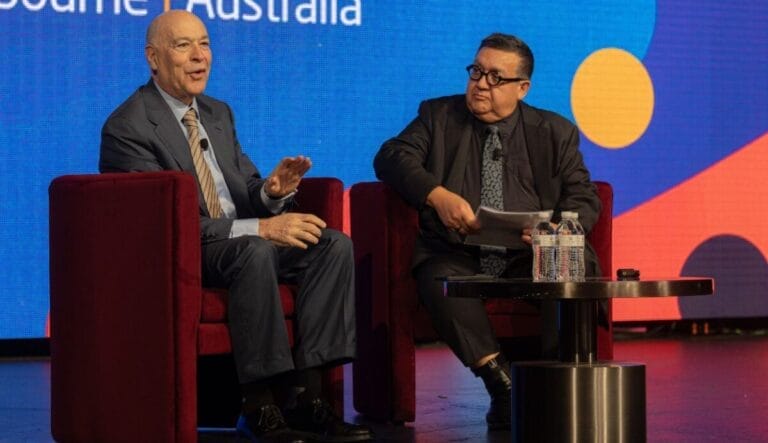
(L-R): BlackRock co-founder Robert Kapito and Hostplus CIO Sam Sicilia. Credit: Neiyo Photography

26/03/2026
hostplus, blackrock, Canva, APFIS


Investments

The war in Iran heralds a period of prolonged market and economic disruption rather than a “short, sharp shock”, according to BlackRock. But investors can’t afford to tear their eyes away from market shifts already underway before the war began.





Leave a Comment
You must be logged in to post a comment.