
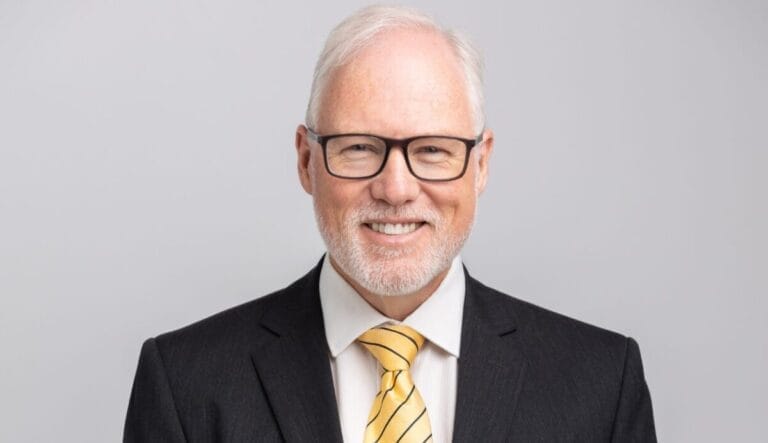

Rest chief investment officer Michael Clancy ends most of his working days meeting members of the fund in a reminder of its fiduciary obligations and the necessity to produce competitive long-term investment returns.
“I think it’s important to have a lens into your membership from a survey perspective, or from a quantitative perspective, but I think there’s nothing quite like going face-to-face with members, whether they’ve got good news for you or not good news for you,” Clancy tells Investment Magazine.
“Each night, when I go home for dinner and I’m sitting around a dinner table with my children, I’m meeting a very small subset of our members. So in some small way, I do that every day when I go home.”
His daughters have been Rest members for some time, but Clancy only joined Rest in August last year after Qantas Super, where he was the chief executive, merged with Australian Retirement Trust. The process of managing the successor fund transfer gave Clancy “plenty of time to think about what next”.
Successor fund transfers “often don’t go completely according to plan, but we were really happy with ours”, he says.
“We landed it on time, only slightly over budget, and we achieved all what we wanted to achieve for members,” Clancy says. “I left that role very, very happy that we did it at the right time. We made those decisions for the right reasons.”
Clancy decided his ideal next step after Qantas would “blend the different aspects of what I’ve done in my career”.
“At my time at Russell Investments, and then at MLC, [I had] very strong investment roles and background. And then later on in MLC, and then at Qantas Super, I had more general management responsibilities. And so if I could find a role that blended an investment background with the need for strong business leadership and culture management and building teams and so on, that would be the ideal role for me. This role at Rest presented itself and turned out to be a great blend of those things.”
Having only known Rest from the outside before joining, Clancy says he’s found that “the characteristics that are talked about externally are what Rest is like internally”.
He describes it as having “great bones as an organisation [and] if there’s one thing which is perhaps different or better than what I expected, it is just Rest’s willingness to have stretchy ambitions”.
At Rest, Clancy leads an investment team of about 130 people, with a support team that takes the number to about 160, a team that he says requires “not only investment, technical leadership, but also business leadership, culture leadership, and building a high-performance team is what we’re all about”.
Best idea wins
Rest conceptualises its investment team in three parts: asset allocation and investment strategy; public market assets; and private market assets.
“In all three of those areas, we’ve got people with great backgrounds, and we have sophisticated, well thought through investment strategies that all feed up to delivering the outcomes to members,” Clancy says.
He describes Rest’s approach as “whole-fund mindset”, a nuanced form of total portfolio approach that operates within the boundaries of a defined asset allocation.
“One of the foundational ideas in TPA is that asset allocation can float free and it’s the best ideas that win,” Clancy says.
“The reality is that we operate in a particular context: there are PDSs which we rightly disclose to members, and we include in that disclosure an asset allocation.”
Super fund members are free to move between funds and “even if members don’t actually move all that often, the funds still compete against one another”.
“So that means that it is important to have some structure, some asset allocation, but within that to find the best ideas. And so that’s what we call a whole fund mindset.”
At around $100 billion of assets, Clancy says Rest occupies a space where it’s big enough to be able to exploit a wide range of investment opportunities that smaller funds often can’t, but not so big that it experiences what he calls ‘diseconomies of scale’ that can plague larger funds that find their investment operations siloed, and communication across the organisation become inefficient.
As a fund gets bigger, “the temptation is to do things in a more complex way”, Clancy says. “And most certainly my point of view on that is we should be as complex as what we need to be to deliver the investment outcomes to members, but no more complex than that.
“Another way of asking [how big is big enough] would be: where do economies of scale become diseconomies of scale? The answer is, I’m not sure, actually, but I know that we’re not there yet.”
He says it’s still possible for Rest to gather all of its investment leaders in one room at the same time, when needed.
Clancy says that Australian super funds are outgrowing the Australian market and increasingly must look offshore for investment opportunities, especially in private markets, and “that means we need to up our game to become world class”.
“That’s what’s required of us over the next three, five or 10 years, and that being the case, no doubt there will be some changes along the way. We’ve got a great team now, we want to make it greater going forward.”
That will include expanding its offshore presence, which currently stands at five people based in London, Clancy says.
“We haven’t made any decision to grow that team at this stage, but that’s the current question we’re asking ourselves. If you take a 10-year view plus, it seems inevitable that we, along with other superannuation funds, will do that.”
Leadership style
With more than 25 years of experience as an investor, Clancy says he hopes the team he leads would say he is “optimistic about the future”.
“It’s easy in markets to be swung from optimism to pessimism on a daily or weekly basis, and I’m not like that,” he says.
“I look at the world and what I see is regular, incremental growth. When you look through all of the noise of geopolitics and macroeconomic changes, generally what we see is slow and steady growth in economies all over the world. If you look at the last century, there has been all manner of economic and human-caused dramas that have led to the rise and fall of markets. But if you look through all of that, what you see is this slow, incremental economic growth.”
Clancy says he is “very happy to take investment risk, rewarded investment risk; very unhappy to take unrewarded investment risk”.
“People would also say about me [that I’m] very concerned about risk management, but concerned about risk management in the service of delivering better returns for members, not for the sake of being conservative.
“And maybe the third thing to say about me as an investor is I really love the last free lunch in investment management, which is diversification. It’s a powerful tool to ensure that, especially when you’re investing such large sums of money, we deliver what members expect in a way which is as consistent as possible.”
As the leader of 160 people focused on delivering returns to Rest’s 2.1 million members, Clancy says “I think people would say about me: cool and calm delivery of whatever it is we’re working on”.
“That might be just through virtue of being around for a few decades and seeing a lot of swings and roundabouts,” he says.
“A lot of things go very wrong and a lot of things go very right.
“And knowing that as those events come up, and they inevitably will from time to time, you work through them with integrity and you work through them with honesty and clarity, but you will work through them.”







Leave a Comment
You must be logged in to post a comment.