


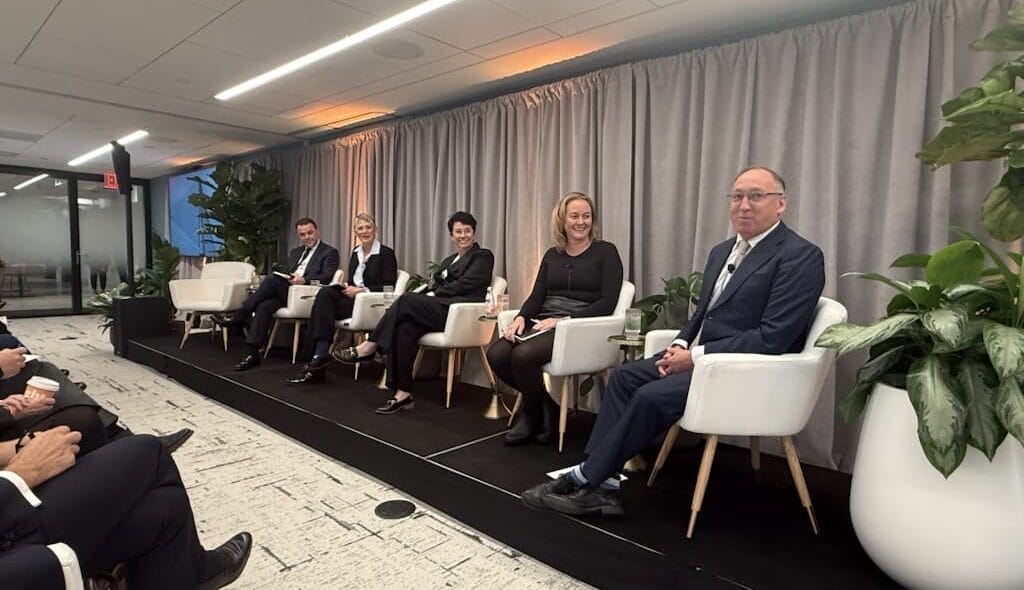
The first two days of the historic Australian Superannuation Investment Summit in the US have given super sector leaders unique insights into the seismic geopolitical and technological changes afoot in the world.
Chairs, chief executives and chief investment officers from retail and industry super funds have participated in a whirlwind tour of Silicon Valley and Washington DC in the past 48 hours, meeting with key officials in the Trump Administration.
After a closed-door session with technologists and venture capitalists at the Rosewood Hotel north of San Francisco, the delegation descended on the Australian Embassy near Dupont Circle in Washington, DC.
They were hosted by Australian Ambassador to the US and former Labor Prime Minister Kevin Rudd, who sources said was in fine form making light of his imminent departure from the role while simultaneously making the more serious case for Australia’s burgeoning position as a significant global investor, including in US assets.
Macquarie Group chief executive Shemara Wikramanayake gave a keynote speech explaining the growing footprint of Australian investors in US markets, while NSW Treasurer Daniel Mookhey promoted the idea of Sydney as an attractive Asia-Pacific destination for global capital.
The delegation also heard from Trump’s official Trade Representative, Ambassador Jamieson Greer; US Undersecretary of War for acquisition and sustainment Michael Duffey; and US Treasury official Francis Brooke.
The sessions were held under the Chatham House rule, and Colin Tate AM, founder and managing director of Conexus Financial – publisher of Investment Magazine – and a delegate to the VIP summit, spoke to sector leaders on the sidelines of the event.
The first iteration of the summit last year drew criticism from some commentators and policymakers after retail funds said attending the tour did not meet their internal best financial interests assessments, as first reported by Investment Magazine.
But the funds attending the summit – which this time around included retail funds AMP, MLC and Colonial First State, alongside all of the major profit-to-member funds and their Super Members Council lobby group – say they have been more than convinced of the clear benefits for members.
“You simply could not assemble yourself the breadth and calibre of speakers that we’ve had over the last two and a half days, and that are still to come in New York,” AMP chief investment officer Anna Shelley told Investment Magazine.
Rest Super chief investment officer Michael Clancy concurred. “In today’s day and age, where what matters most is geopolitics and technology in terms of changing the world in which we live, we have got ringside seats to the people who are changing it,” he said.
“Australian super funds are already very large compared to the Australian domestic market, and over the next decade will approximately double in size – and will become a large proportion of Australian GDP,” Clancy said.
“That means we will continue to, and in fact will more so than even what we do today, invest offshore. America is, by far and away, the largest offshore country in which you can invest, and so we have to have our finger on the pulse of the things that are driving the American economy.”
MLC CIO Dan Farmer said that, though some Australian super funds “could get access” it would most likely occur “over a video call” and “you have to work very hard” to obtain exclusive insights.
Hyperscalers and hype
But it was the conversations around the rapidly escalating technology disruption in AI that rang most loudly in the ears of senior investors attending the tour.
Chief among them a meeting with a co-founder of Anthropic, the artificial intelligence company disrupting global workflows with the latest version of its Claude AI tool.
Farmer said the Silicon Valley sessions helped answer the question of whether the extraordinary appetite for compute infrastructure is real or approaching its peak.
“It’s given me confidence that demand for compute has been huge,” he said.
“There’s been a lot of questions about when is that going to peak? Certainly, the view from the participants presenting in Silicon Valley was, this is where demand comes online, and the data centre is going to be used and revenue accreted for the hyperscalers. So it’s confirmed what we felt, and it’s given us, given me, a bit of extra conviction in that trend.”
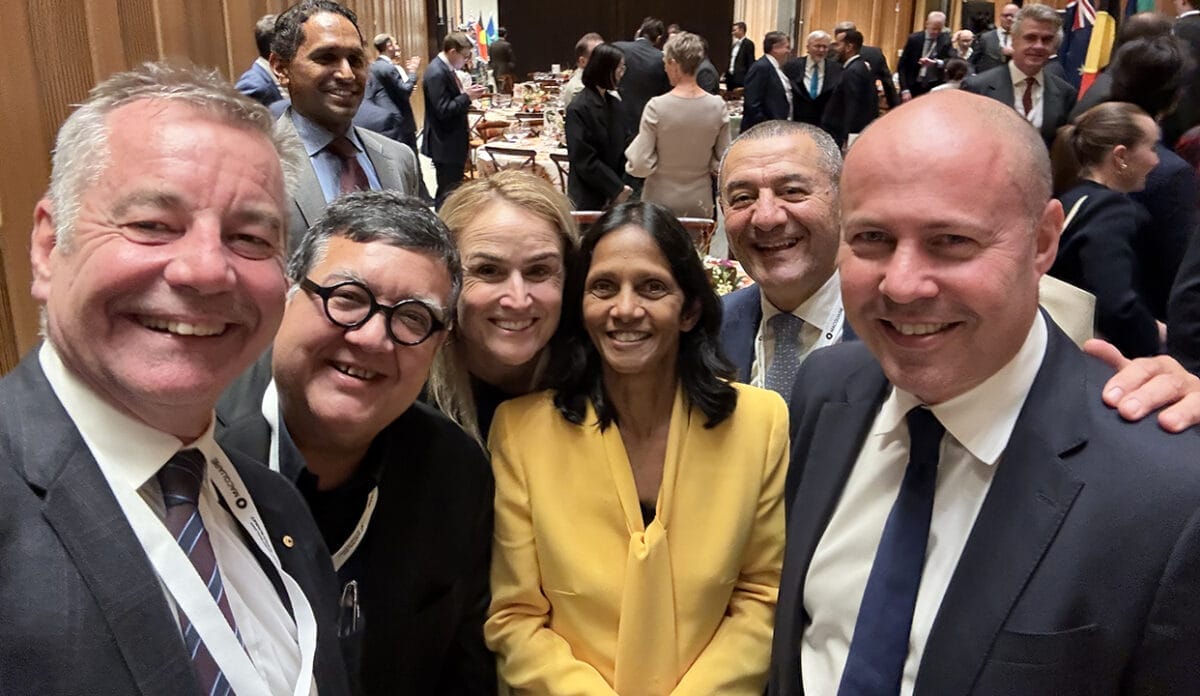
Farmer said it was heartening to see that “the size of the Australian super industry has obviously attracted that calibre of people to come and talk to the group firsthand”.
“We’ve got analysis coming out of our ears, but to hear those firsthand insights from the actual top key people that have founded these businesses is something that’s not super easy to get.”
For Cbus CEO and former CIO Kristian Fok, the more significant takeaway was not about any single company but about the speed at which the whole sector is moving.
“One of the interesting things was that [Anthropic] were probably the first to use the latest generation of Nvidia Tensor cores. One of the insights is that their competitors are also training on those same cores and will probably be releasing their models.
“So I think it’s less about Anthropic but more around the pace of advancement of all AI models that we’re going to see – this increasing in capability at an exponential pace, I think, is the big thing.”
Fok said that insight had direct implications for how funds think about their own operations, not just their portfolios and he said funds must consider AI’s impact on hiring people and app development, and the threat that quantum computing poses to existing security infrastructure.
“For me, it’s bringing it back to how do we make sure that any decisions we make around our own technology, we don’t find ourselves left behind after six months, for instance,” he said.
Clancy said there remain limits on predicting the longer-term implications of AI on fund operations, even though there’s clear evidence of the benefits it’s delivering.
“I think the starting proposition has to be that we can’t know what the long-term change will be like,” he said.
“However, certainly within our investment team at Rest, the intersection of human intelligence and artificial intelligence is saving a lot of time and means that we can be more effective at our jobs in making investment decisions on behalf of members – but we’re right at the start of that. Where it ends, I don’t know, but it’s an exciting time.”
Signal in the noise
Once the conversations shifted to the major changes afoot in US domestic and foreign policy – and geopolitics more broadly – again the delegates canvassed pointed to the utility of insights gained in-person and distinct from the narratives concocted by the mainstream news media.
“If you just read media, the normal media discourse, then you might think that what the Trump administration is doing on the global stage, especially around trade and relationships with other countries, may feel haphazard,” said Clancy.
“But when you’re listening to the people that are actually designing the policy, that are moving it forward, as we’ve had the benefit of doing, then you see that actually there’s a strong rationale for a lot of what is being done.”
Farmer said the overarching logic connecting technology leadership, national security, and private capital was made clear.
Shelley said meetings with members of the Trump administration illustrated “that there’s been a lot of people come out of the business sector, out of private equity as well, going into government, so there’s this pragmatism in the government, and this willingness to cooperate with the private sector”.
“That’s pretty instructive, and it does give you a bit of confidence in the investing environment in the US.”
A philosophy of government stepping back to let private capital lead the way has direct portfolio implications, which Fok said creates opportunities for US allies such as Australia.
“Not unilaterally, but there is also a role for countries, including Australia,” he said.
“So, for us, understanding beyond the noise – the motivations and the mechanisms that are being put together, and how they are trying to make sure that private capital in its forms would be attracted to that on a commercial basis – I think is very important.”
Delegates also met US state governors, and Shelley said that while she imagined there might have been diversity in the different states’ views.
“The ones we heard from were certainly very proactive – run by former businessmen, people from the private sector – very pragmatic about what their states needed, about the opportunities, largely infrastructure-related.”
The big picture technological and geopolitical trends reshaping institutional portfolios will take centre-stage at the upcoming Fiduciary Investors Symposium in the NSW Blue Mountains on 12-14 May 2026. Click here for more information or to register.






Leave a Comment
You must be logged in to post a comment.