
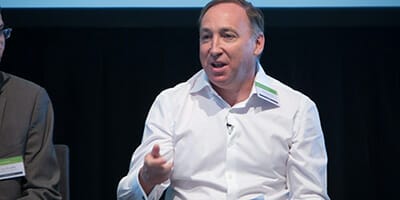

The chief investment officer of AustralianSuper gave delegates at the Fiduciary Investors Symposium an insight into how he diversifies his fund’s portfolio, Mark Delaney’s advice came with the caveat that no process of diversification could ever be perfected.
“You cannot solve for uncertainty by adding more precision, it is elusive,” he told delegates. “You need to accept there is uncertainty and try and deal with it as effectively as possible.”
Delaney splits the process in two; firstly spreading out the sources of return, on the basis that the future is uncertain and there is no guarantee that one particular source of return will be the one that delivers. Secondly, he manages the short term volatility of these asset classes.
Before embarking on diversification, he said there needed to be recognition that diversification is rarely costless. “As soon as you diversify away from highest returning asset class you can be giving up some return,” he said.
One of the common problems in achieving true diversification is that some asset class allocations can end up being over diversified by stocks, but under diversified by asset classes. “Clearly the more asset classes you can get the better in the portfolio, but it is hard to really do in practice,” he said.
He added that the approaches to diversification such as mean variance, risk parity and volatility parity all use the same asset classes and so face similar limitations.
“The building blocks are all the same, so having more lego is a better idea.”
He added that while all these approaches had their worth – “all of them have good insights, so you would not throw any of them out” – they depended on historic data which could not be fully relied upon.
“When you go back and look at adverse events each one of them is different; the future is never like the past. So we think a mixture of qualitative, future orientated looking with stress testing and quantitative approaches is the best of both worlds. You need to blend in both of them and it is not an exact science,” he said.
He was sanguine on the success rate of various diversification approaches, particularly with reference to the history of returns from equities and bonds.
“Diversifiers only really work half the time if you are lucky,” he said. “So we say you need to diversify your diversifiers because they are only going to work half the time.”













Leave a Comment
You must be logged in to post a comment.