
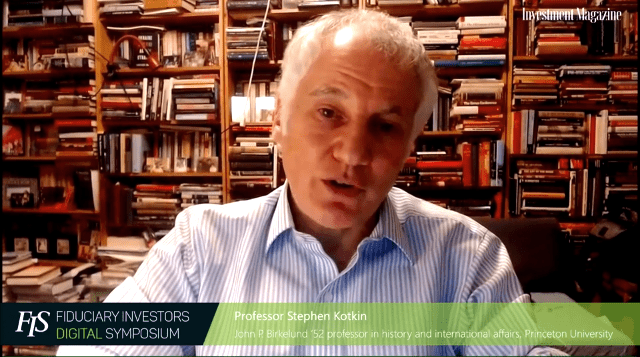

[vc_empty_space]Princeton historian Stephen Kotkin said governments were approaching a “dangerous situation” if they did not hurry up and find a way to balance the safety of their citizens from the pandemic with their ability to earn a living.
Speaking at Investment Magazine’s Fiduciary Investors Digital Symposium from New York, Kotkin said countries were in “big trouble” if the global shutdown to contain the virus dragged on for too much longer because people would ignore the experts’ advice and stop practising social distance in favour of work. He also warned of the “debt bomb” that had accumulated in the financial system thanks to extraordinary policy measures which had now become the norm.
“It cannot go on forever,” he said of the strict social distancing measures. “The people living the decisions aren’t involved in making the decisions and that is a very dangerous situation if it continues for too long – I’m very worried about that. The people on the receiving end of those decisions can’t work from home and don’t have salaries.”
He also noted that the COVID-19 pandemic, which has killed more than 340,000 people so far and put millions of people out of work globally, was not unprecedented despite its constant reference to the virus. The professor of history and international affairs said the outbreak of smallpox and the bubonic plague between 1300 and 1600 had also resulted in quarantining, social distancing and severe economic costs but without “the science to understand it.”
“There is no such thing as after COVID, there is only with COVID,” Kotkin said. “With COVID it doesn’t have to be as crazy as it has been up until now. It’s a long story to discuss whether the lockdown policies made sense or were necessary. We can’t do that right now but going forward we have to be much smarter and more nimble.”
He said that governments needed to reduce the so-called “super spreaders” of the virus with less destruction of gross domestic product, before adding that leaders in the private sector stood to “command tremendous market share and even monopolies” if they figured out a way to operate safely in the current environment.
“We can’t have the status quo continue going forward,” Kotkin told delegates. “As we come out of this… it will be up to individuals to make those decisions and weigh the costs and benefits. People are looking at Australia and Denmark and (are thinking that) maybe we don’t have to destroy our economy to be safe.”
Kotkin named Australia, New Zealand, South Korea, Taiwan and Denmark as successfully managing the outbreak. He also cited Singapore, which after its initial success forgot about its “gigantic population of non-citizens who come from lesser advantageous places.”
“It’s not just government policy, it’s also the population’s trust in the government and people changing their social behaviour on account of their fellow citizens which we are seeing in successful countries.”
Kotkin also warned delegates of the “debt bomb” that had accumulated in the financial system because of measures taken by policymakers to stave off a downturn which he said “would not end well”. He cited China’s vulnerability to rising company defaults because it was the biggest lender to distressed companies globally.
“We are not investing in infrastructure or human capital by taking on debt that we supposedly are not going to have to pay back,” he told delegates. “We are doing things like sending cheques to people on a fixed income who have not been adversely affected by the pandemic. There is a bunch of craziness and it’s not clear where it’s going. It’s no longer a crisis response, it’s now the system.”
All content from the Fiduciary Investors Digital Symposium which includes the session video recordings, a dedicated podcast series and thought leadership whitepapers are now available on our digital content hub here.












Leave a Comment
You must be logged in to post a comment.