


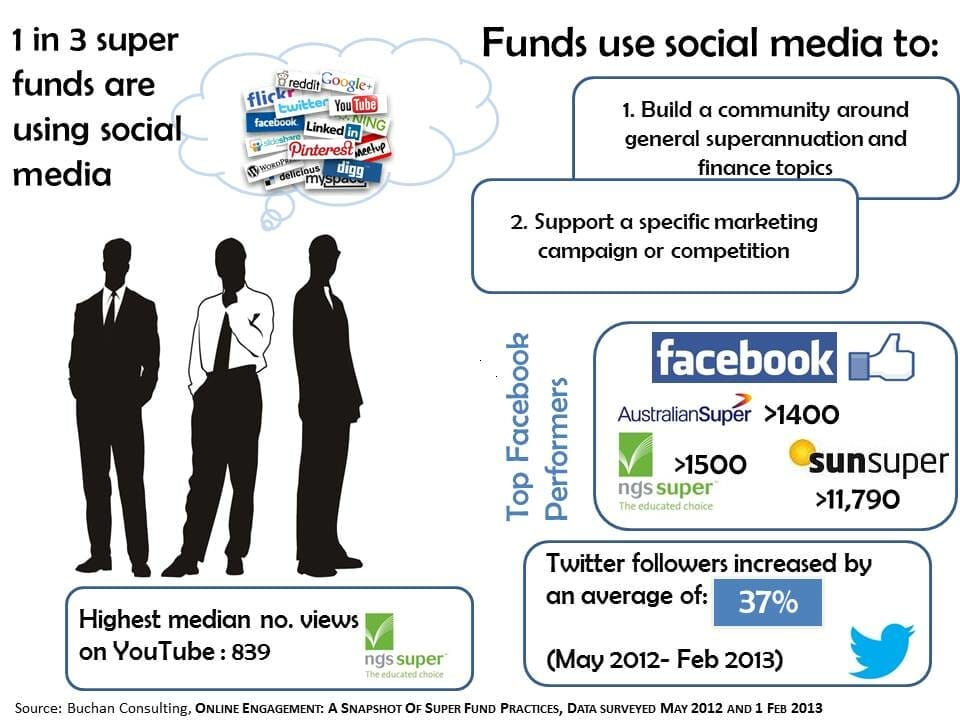
Industry funds are taking to social media engagement, but an aversion to risk and leaner resourcing means Australian funds still lag behind other countries. An analysis of the social media footprint of 34 super funds shows that only approximately one-third of funds have a searchable social media presence, with levels of engagement varying significantly.
“There’s a lag effect and there is a need for education at chief executive and leadership levels. Because once you’ve got buy-in from the CEO and his or her leadership team, you see significant change in terms of how that [organisation] embraces social media,” says Tom Buchan, principal at Buchan Consulting.
“I think that’s changing gradually rather than rapidly, but we’re seeing significant changes.”
The analysis, an update on a May 2012 study by Buchan Consulting, which advises on and implements social media for organisations, reveals some funds have low searchability or lack of integration with a website, while others only used social media to drive specific campaigns.
Stats from the Tweety pie
Only two funds have created a social media presence since May last year, but Twitter followers have increased for most funds, with Australian Super’s (@AustralianSuper) following growing by 85 per cent, from 570 to 1053. The average increase was 37 per cent, with Equipsuper (@Equipsuper) and Catholic Super (@catholicsuper) sitting on average. The highest Facebook engagement came from NGS Super, SunSuper and AustralianSuper.
Attention to risk management has also slowed financial services down, according to Buchan, who says it’s not unusual for CEOs and boards to query how to mitigate risk in social media platforms. But he believes funds should be willing to invest resources to monitor what’s being said.
“Then it’s good old-fashioned direct, open, honest communication as quickly as you can. That’s standard practice for good communication.”
Yet, engagement is rising. Just last year, the Australian Institute of Superannuation Trustees awarded diversity in super fund communication strategies in its 2012 awards.
Branding dialogue
Anthony Rodwell-Ball, CEO of $5-billion fund NGS Super, says it’s a good brand investment and that electronic communications are a means of effectively and cost-efficiently reaching out to members.
“Social media undoubtedly is the communication platform of the future. It provides an environment for members to pull information rather than us continually having to push it. And really, if you think about it as an industry, we push a lot of stuff out – we have to because the law requires it.”
Meanwhile, Rodwell-Ball, who says the fund is engaged on various social media channels, including Twitter, Facebook and Pinterest, believes there’s great focus on risk and not opportunity.
“I think that will change in time. You’ve got be alert to what people are saying about you.”
Umberto Mecchi, executive manager of strategy and marketing at Hostplus, agrees, saying in terms of public and reputational risk, it’s far better to welcome dialogue and respond positively than be oblivious to it.
“Social media is a good listening device before joining the conversation,” he says. “Quite often, if you can respond to a criticism or a pain point for a customer really quickly, what you’ll see is they go back online and say thank you, and actually applaud your effort.”
He says the fund is not media biased, but tries to cater to the various demographics of its membership. Hostplus’ most notable engagement has been in Cook for your Career, a partnered cooking competition to address Australia’s lack of chefs, now in its third year.
“We had a dedicated Facebook page… and it’s called Cook for your Career, not Hostplus. And we did that quite deliberately,” he says.
“It builds good will for the brand and makes us a perfect partner for the community.” 
Teifi Whatley, Sunsuper’s general manager of customer experience and insights (pictured right), doesn’t believe funds have the luxury of not engaging in social media, particularly in terms of managing and monitoring public activity involving the fund.
“You don’t want to go in without your eyes wide open, because at the end of the day, the customer is in control of these mediums. And we’ve all seen instances where things have gone very pear-shaped around social media.”
Sunsuper’s Dreams for a Better World campaign, which has more than 11,000 likes on Facebook and has been running since February 2011, was part of the organisation’s strategic approach to social media, and an attempt to engage meaningfully with its under-40s membership.
“We knew that they were not necessarily fully engaged in superannuation, but our research was telling us that they were in fact quite socially conscious,” Whatley says. “We also knew that they tend to be social media users, so it seemed to be the perfect opportunity to start that program.”









Leave a Comment
You must be logged in to post a comment.