


The boundaries between asset buckets in fixed income are blurring as sovereign and investment grade credit ratings converge, according to Barney Goodchild, head of fixed income and equity investment specialists at Aviva.
Goodchild, who is London-based, said the traditional assumptions fixed income investors rely on are changing. This leads to the question of whether previously distinct categories like emerging market credit, sovereign debt and high yield bonds remain separated.
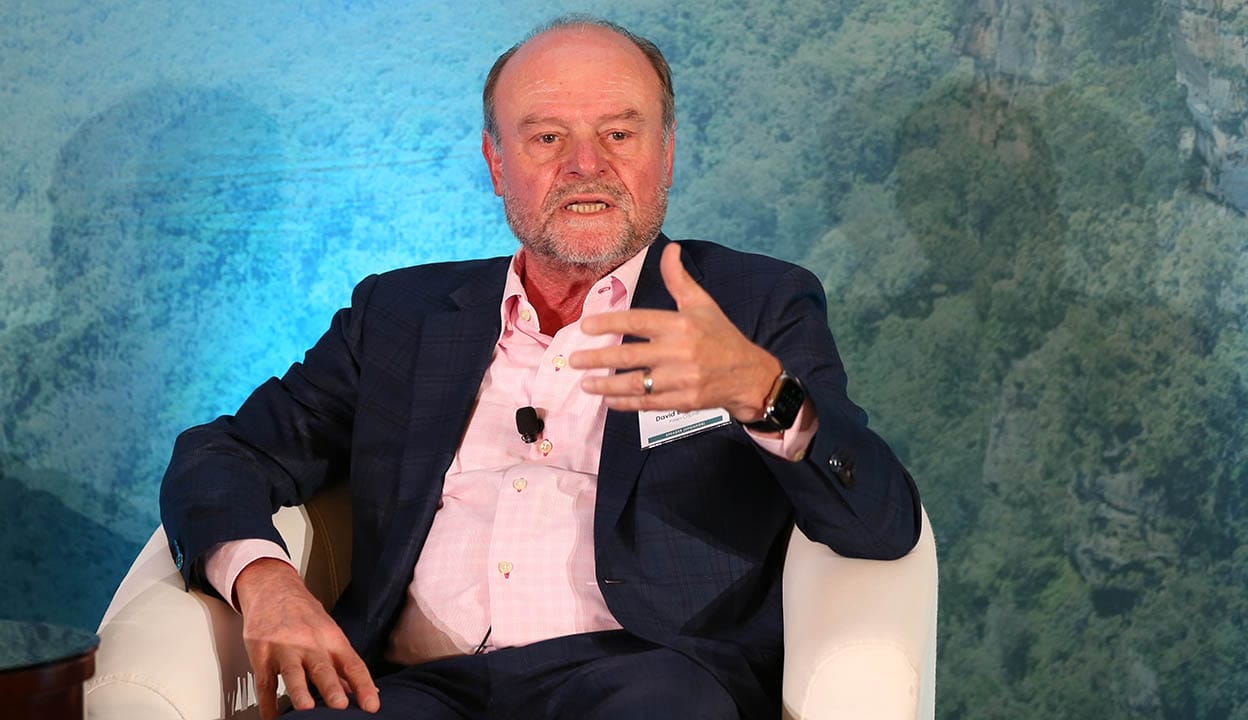
“If you think about the world from a fixed income perspective, the asset class was organised by some pretty kind of clear, mutually exclusive buckets,” Goodchild told the Investment Magazine Fiduciary Investors Symposium.
“These provided a pretty good guide as to what was happening underneath, and what kind of risks you could expect, what kind of outcomes you could expect in that world.
“I think the question [now] is, does that still make sense? Does the world still reflect that?”
One prominent convergence is between emerging markets and developed markets as sovereign debt levels balloon across advanced economies. Investors can no longer safely make the assumption that developed markets are fiscally and politically responsible anymore, while emerging markets governments “got their act in order”, said Goodchild.
The gross debt of countries with AA+ credit ratings from Fitch stood at 125 per cent of their GDP in December 2025 and is forecast to reach 143 per cent in December 2030. However, the gross debt of countries with BBB credit ratings stood at 77 per cent of GDP in 2025 and is expected to reach 87 per cent in 2030 – a significantly lower proportion, according to data compiled by Aviva.
Another confluence is between investment grade and high yield credit, where investors are increasingly asking the question of whether the two still provide sufficient diversification benefits in a portfolio, Goodchild said.
“When I started out, your high yield was really quite racy, IG was pretty high quality. What’s happened over time is those two asset classes have just started to converge more and more in the middle,” he said, adding that US investment grade credit has gravitated towards BBB while US high yield is shifting towards BB.
“I was speaking to a client last week, and they were talking about how they keep their [IG and high yield] portfolio quite separate. I said but when you look underneath, in terms of the actual quality of the assets, they’re very, very similar, albeit you have these two quite distinct labels.”
One of the most direct portfolio construction consequences of these convergences is investors need to be clear on what they want to get out of their fixed income assets.
“The traditional view [is] you’ve got your rates, you’ve got your high yield, you’ve got your IG, you’ve got your EM – to me that world has kind of moved on,” Goodchild said.
“Really it’s about thinking about what role does this asset play in my portfolio? Is it there from a capital perspective? Is it there from an income perspective?”
It also means the opportunity set has broadened out as asset buckets cross paths with each other. Goodchild said the company has been seeing opportunities in nascent areas such as corporate hybrids, which “just didn’t exist three or four years ago”.
“[With] changing US regulation, suddenly it’s bigger than European high yield. [It’s] an asset class that is kicks out great levels of income, highly secure cash flows, and quasi IG rated,” he said.
“So fixed income is back, depending on where you need it in your portfolio.”




















Leave a Comment
You must be logged in to post a comment.