


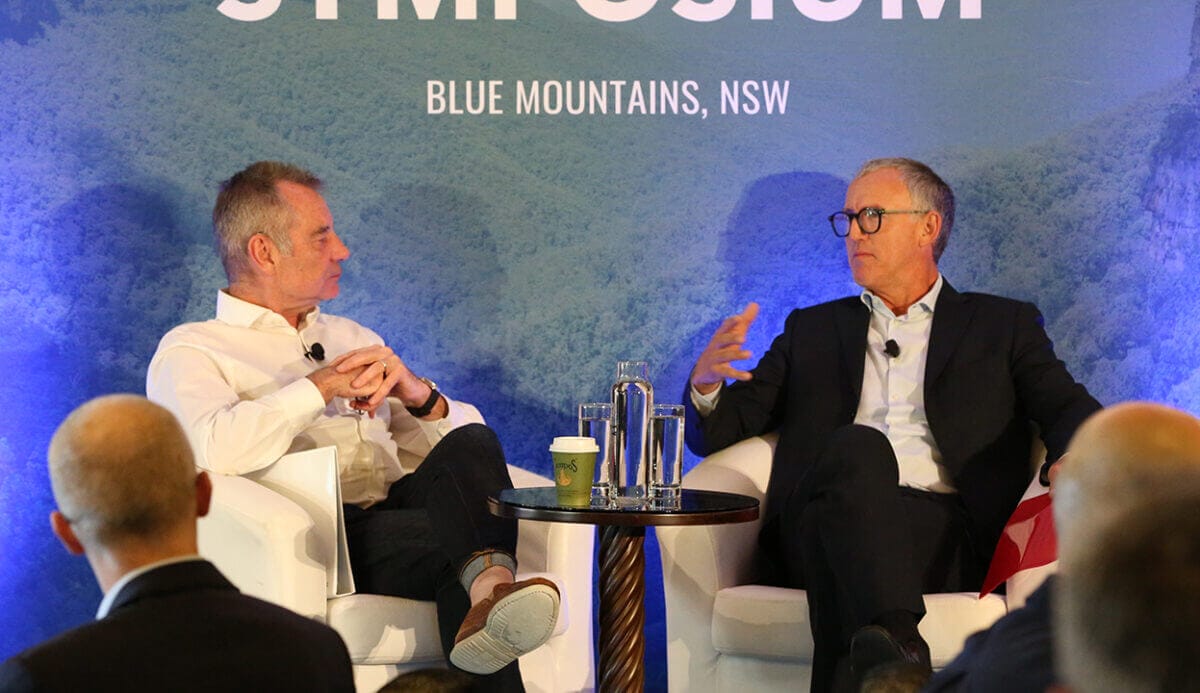
For the first decade and a half of his career investing in electrification, Blackstone private equity group senior managing director Bilal Khan said that demand for electricity in the United States was flat.
“In some cases actually it was negative,” Khan told the Investment Magazine Fiduciary Investors Symposium. “I remember telling my wife when I made partner at Blackstone, I don’t think this electricity thing is going to work out for me very well.”
Khan told the symposium that Blackstone has now invested in the energy transition for 30 years, generating a net 30 per cent return with no realised losses.
“We invest across the full ecosystem, and one of the reasons why we believe we are well-placed to invest across the full ecosystem is the fact that we’ve built these facilities, we’ve operated these facilities, we’ve maintained these facilities,” he said.
US electricity demand is projected to grow at between 3 and 5 per cent a year over the next decade. Khan said roughly half of the demand comes from data centres and AI, and half from US re-industrialisation and reshoring, including semiconductor manufacturing. Chip fabrication is electricity intensive, and the US now treats domestic manufacturing capacity as a national security priority.
Khan said that even if demand from AI is assumed to be half of what’s forecast, “you’re still at a pretty robust growth rate for electricity”.
Solar and wind have accounted for 80 per cent of new US generation over the past decade, and Khan said that would continue irrespective of who occupies the White House, mainly because “solar today in the United States is, in fact, cheaper than natural gas – that is a very, very powerful statistic”. Even in Texas, a meaningful share of generation is now renewable.
But Blackstone has also built 3GW of efficient gas-fired power generation, including the first natural gas plant in West Virginia, a state where almost all baseload generation had been coal. Displacing coal with gas cuts carbon intensity by 50 per cent.
‘Never better on an unlevered basis’
Khan said that before Covid it was “really difficult to earn a private equity type of return investing in solar and wind.” But today returns from building new generation assets “have actually never been better on an unlevered basis”.
Blackstone holds the largest battery storage platform in North America of 5.4 gigawatts, which it backed in February 2020 when the underlying business had less than US$10 million in EBITDA. Khan said the business will generate EBITDA “just shy of a billion” dollars when all projects are online. Contracts run for 18 years on a weighted average basis.
US electricity prices are up two to three times over the past five years, in part because an ageing grid cannot deliver supply to meet demand fast enough. Blackouts have increased five times since 2000, and utility capital expenditure is up more than 50 per cent, and Kahn said transmission capex specifically had almost doubled.
A 1.3 gigawatt buried transmission line bringing hydro and wind power from Quebec to New York City is on the verge of starting commercial operation, after a test run at 24 per cent of the city’s grid. Khan said the line carries a 40-year contract with Hydro-Quebec, owned by the government of Quebec, and took eight years to permit and five more to commercialise.
The Trump administration is not the reason New York State renewables have stalled, Khan said. “It was just New York State. New York City had a process for soliciting renewables that was broken.”
He said Blackstone’s data centre exposure spans power provision through to cooling technology. Lancium, a Blackstone investment since 2024, provides electricity to hyperscale facilities including the first Stargate site in West Texas, chosen because cheap renewables keep power costs low.
Khan said stranded asset risk – the “sheds with air conditioning” angle – is mitigated by contract duration: 15 to 20-year agreements with investment-grade counterparties, structured so investors recover capital and return within the contract period.
“You compare that to what we’re doing on the digital side, which is 100 per cent leased for 15 to 20 years,” he said. “It’s a completely different paradigm.”
Building a new transformer involves a three-and-a-half year wait; new gas generation from General Electric takes six years; and fixed-price construction contracts for combined-cycle plants are “not really fixed price anymore”. Construction labour shortages are a “real phenomenon across the developed world”.
The same constraints create pricing power for experienced developers.
“There are all sorts of risks that are allowing developers that have good projects, that have experience in building these projects, to actually set the price,” he said.
Khan said political risk may be mitigated by investing in electricity that is affordable and reliable.
“Whether you’re a Democrat or a Republican, it’s a winning argument.”






Leave a Comment
You must be logged in to post a comment.