
The $230 billion Aware Super has been in “build mode” for the past decade, according to its new CIO Simon Warner, but he thinks it’s time to start optimising that work to make sure the fund can achieve its aspiration of delivering top-quartile investment returns at bottom-quartile fees by 2030.
“One way of thinking about our task is that we pay away roughly $1.25 billion per year to manufacture that portfolio. Some of that is the internal team, and the rest of it is our external managers,” Warner told the Investment Magazine Fiduciary Investors Symposium in the NSW Blue Mountains in his first speaking appearance since taking on the top investment job at Aware.
“[We have to] think about that $1.25 billion and whether we’re allocating it optimally. That’s no comment on the way we do it now; it’s just very unlikely to think that we do it optimally, because it’s a difficult job – so let’s see what we can make of that.”
Warner estimates that around 15 to 20 per cent of that $1.25 billion cost comes from Aware’s 150-strong team of investment professionals, but he doesn’t plan on cutting headcount.
“I think that instead of the frame of reference that I won’t need some of those 150, I think pointing those 150 towards [solving] the $1.25 billion cost will yield massive improvements for my members,” Warner said, adding that Aware would look for efficiencies through artificial intelligence.
“Using LLMs to inform the investment decision and stop making silly mistakes – wow, that seems like there’s lots of low-hanging fruit. Using an LLM independently in an active process that a human hasn’t architected – I struggle with that.
Something else Warner thinks is vital for delivering on his 2030 goal is the hybrid investment approach that has seen Aware use both internal and external strategies, occasionally switching between them within asset classes depending on what it believes is the best “access point” at any time. Warner said that hybrid model is increasingly important as Aware’s overseas asset base – and the UK office it has opened to service it – continue to grow.
“We need to be able to get great quality assets overseas, and at a price that is not just purely through GPs. And so having those private market professionals there on the ground is a critical part of that.”
It’s a “big shift” for any organisation to have a second office, Warner said, adding that – if they aren’t carefully managed and integrated into the broader organisational culture – they can lead to its “terminal decline”.
“I’m attuned to that, and we’re trying to do it in a very thoughtful and methodical way. Damien Webb helped us set up that office, and setting that office up with the right culture and imbuing it with our way of working was incredibly important, and we don’t take that great progress that we’ve made on that front for granted.
“It’s now about how we bed that down, because the organisation has to be around for 100 years, and we’re trying to take that timeline.”
Trading Places
Warner started his career trading the balance sheet of Chemical Bank, which later acquired Chase and then J.P. Morgan. He told the symposium that trading is a “really quite brutal pursuit”, but one that teaches you “about yourself and your limitations”.
“There is no role for hubris within that task, where in other tasks within the investment industry you can sometimes sit a degree away from the outcomes and not allow them to penetrate your own sense of self,” Warner said.
“Candidly, I found trading extremely difficult. Trying to figure out where interest rates and currencies are going – the most transparent, the most liquid, the most highly arbitraged market in the world, where there is no asymmetry of information and no excess return you can harvest just by being sensible. The expected return is zero.”
Warner soon learned that he “wasn’t one of those people who sat on the desk and pontificated about what is going to happen next”.
“Whenever I thought I was on to something, it turned out to be generally wrong. And I spent most of my time figuring out when to stop losing trades, and that caused me to get very introspective about how to create a methodology where I was maximising my chance of being right and managing myself when I was inevitably wrong. In my early career, I found it an affront to my ego to be wrong, and that’s a brutal place to be as a trader.”
At a $230 billion super fund, Warner thinks about risk somewhat differently – as an investor, rather than a trader, though he said that both disciplines have an equally strong sense of risk management and clarity of purpose.
“What’s happening right now is that there is obviously a dissonance between the news flow and the price action. And it’s appealing to think that the news flow is just chatter and the price action is accurate, but in my role I need to make sure that I’m covering the possibility that the news flow is accurate and that things are going to get a lot worse.
“One way of being able to parlay your status as a long-term investor into value is the ability to act when others can’t. And so using that lens with respect to our stress tests, if equities were to fall 15 to 20 per cent, do we have the capacity to act, are we playing defence, or are we, God forbid, reducing risk at a point which is inopportune?”

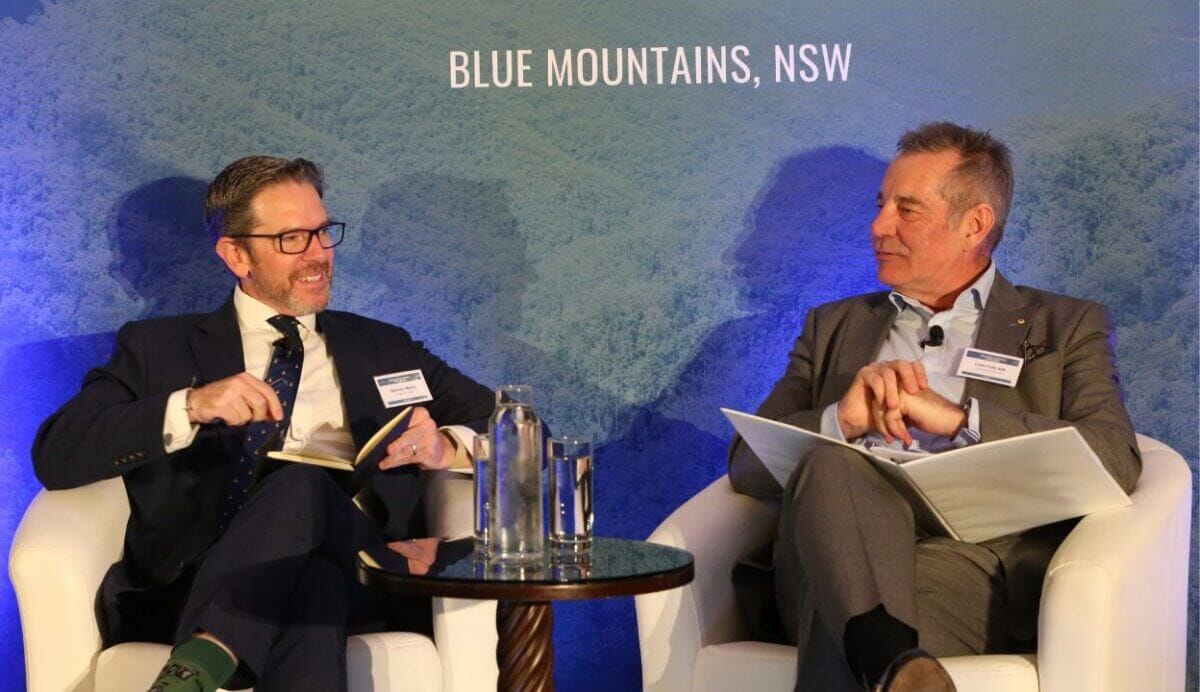
(L-R): Colin Tate and Simon Warner

15 May 2026 15:58



Leadership & profiles

The Future Fund’s new position paper is useful for anybody trying to imagine the possible futures of our increasingly wild present, but it is the AI threats that are already emerging that investors should spend their limited attention budget on.










Leave a Comment
You must be logged in to post a comment.