
Super funds are coming under increasing pressure from APRA and ASIC to demonstrate how they’re using and thinking about AI. But Paul Newfield, director of sector research at Frontier Advisors, said the regulators are less interested in security protocols and tools than they are in how AI is actually being used in decision-making.
“Because I suspect that, regardless of the protocols that exist today, in most funds the shadow AI risk is larger than the AI program,” Newfield told the Investment Magazine Fiduciary Investors Symposium.
“Thirty years ago, when you asked someone to do a piece of analysis, they’d get a whole bunch of data, they’d run a spreadsheet and do calculations and come to you with a report and you knew where all of that came from.
“When you get a report today, you have no idea whether AI has contributed to it, whether it’s had a bias in a particular direction, whether they’ve constructed a model to promote the original thesis that you put forward.”
What’s helpful for that problem is to understand the biases that are baked into AI, according to Anthea Roberts, founder and CEO of AI firm Dragonfly Thinking.
“Without a shadow of a doubt, what’s baked into most of the models at the moment is an English language, Western/American bias, because it dominates a lot of the training data,” Robert said. “That means if you ask a general answer you will skew towards the middle of that distribution.
“But there’s an extraordinary amount of ways to get information out of these models that help take you away from that – so if you change the nationality of the profile that you were asking, and change the language that you ask the question in – if you do all these moves to help situate the model in its latent space outside of the mean of the distribution, you will get very different answers.”
Roberts said that the “power users” of AI in organisations often aren’t those with a background in traditional computer science or who are more attracted to deterministic ways of thinking. They instead usually have “high agency and high curiosity”, or “metacognitive” ability.
“The ability to think about thinking, to think in structured frameworks, to be able to do one or two levels of abstraction up about what work you want to do and what does good look like in order to do verification,” Robert said, adding that she thinks that cognitively diverse people – like those on the ADHD spectrum – will also do well with it.
“The last point – the growth mindset. This is changing so fast that you have to not just have openness and curiosity to learn, but you have to unlearn and relearn and unlearn and relearn, and that is brutally hard. And so having that ongoing mindset is a really key ability to not get stuck on the first AI hill – but to rip that down and go to the second one and third one.”
Megan Ford, executive director of investment capability and intelligence at the Future Fund, said that the experience of integrating AI across the investment team and other areas of the fund has hewed closely to Roberts’ analysis of “power users”.
“When we first started this journey, people that think in a very structured way found it quite easy to engage with AI because there’s a process that you go through in how you think about and structure your questions. People who do have more experience from the investment side, or whichever area you’re using the AI for, are better placed to spot hallucinations and challenge AI,” she said.
“As people have been trained on those tips and tricks, what we’re now seeing is that our power users have that growth mindset and are really curious and will keep asking questions. They’re happy to try new ways of learning, they’re happy to think differently about how you approach a problem or solve it, and they’re the people that are, yes, happy to burn some tokens to learn. And that’s probably the change I’ve really seen over the last six to 12 months.”
The Future Fund’s AI program grew out of questions it was asking about how it could better capture and share intelligence across its organisation, which began even before the proliferation of LLMs. In answering those questions, it spent significant time building out its data structure and storage – a foundation that has allowed it to move somewhat faster than its peers on AI.
“For us it’s about how we improve our culture and improve the investment outcomes that we’re here to achieve. There are productivity benefits that come from it, but that is not our focus.”
Brendan Donoghue, head of digital customer and experience at UniSuper, said the lesson the fund has taken away from two years of AI implementation is simple: start with the problem you’re trying to solve, not technology. The fund found its use model in Changi Airport, which uses AI to distinguish runway debris from insects, and applied the same logic to compliance monitoring, building a capability that has rapidly streamlined the work of compliance.
“I was tying up compliance people, product people, legal people who are brilliant individual thinkers and who were doing the equivalent of parking a car – looking at this data and telling us that we’re compliant. AI has completely changed that for us internally and what we’re able to do in these spaces by looking at what was a global leader in the space for inspiration.”
Newfield agreed that the starting point should always be working out the challenge you’re trying to solve and looking to others for inspiration before “diving into AI to solve everything”.
“AI, at the end of the day, is a governance challenge. It’s about using it in a sensible way. Someone said to me, and I’ll plagiarise it – humans working with AI is the best outcome., Think Iron Man more than Terminator.”
“I think it always comes down to good governance and sensible thinking. Having fancier models and fancier tools and more data doesn’t make you better. Ultimately, what you want is wisdom – thinking in a constructive way about, how is [AI] posing the solution? Has it considered all the different angles? What are the counter claims, have you got controls? And these are the questions that the regulators and, increasingly, organisations, will be asking.”

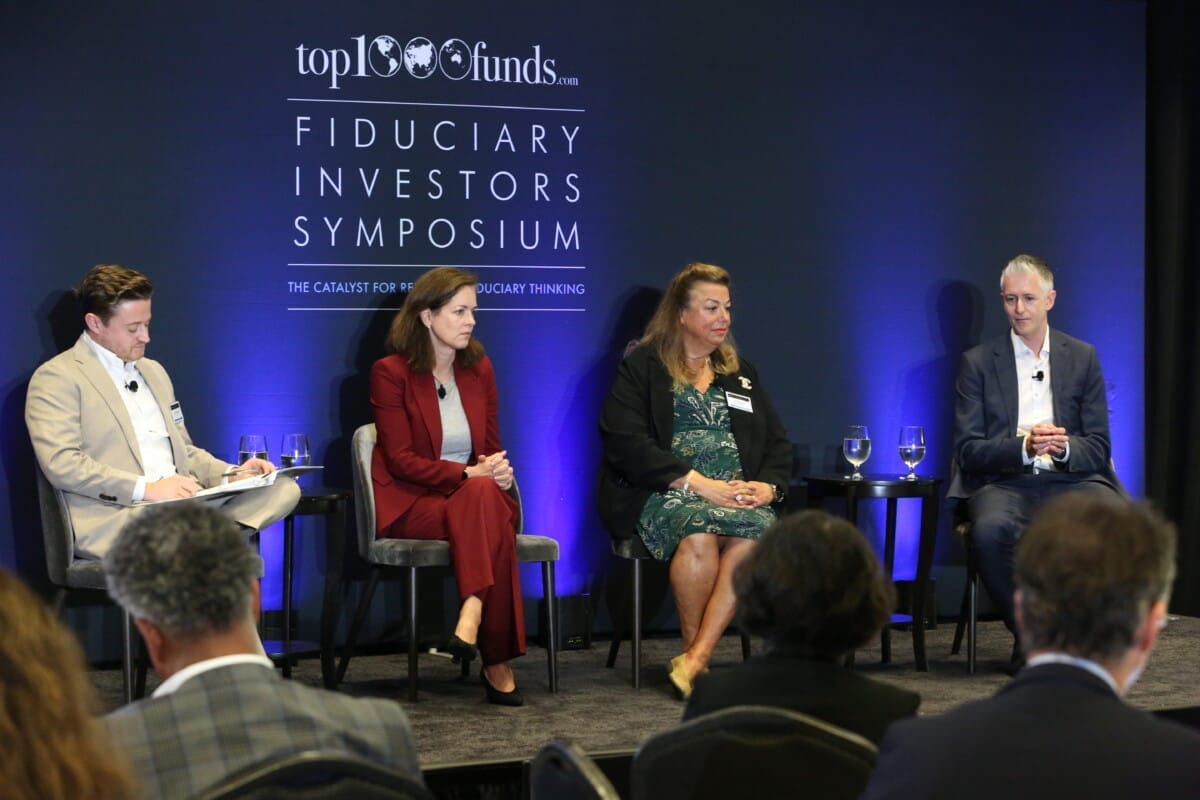
(L-R): Lachlan Maddock, Megan Ford, Anthea Roberts, Brendan Donoghue, Paul Newfield.

22 May 2026 16:10
unisuper, Future Fund, Frontier Advisors, Dragonfly Thinking



Technology

The Future Fund’s new position paper is useful for anybody trying to imagine the possible futures of our increasingly wild present, but it is the AI threats that are already emerging that investors should spend their limited attention budget on.













Leave a Comment
You must be logged in to post a comment.