


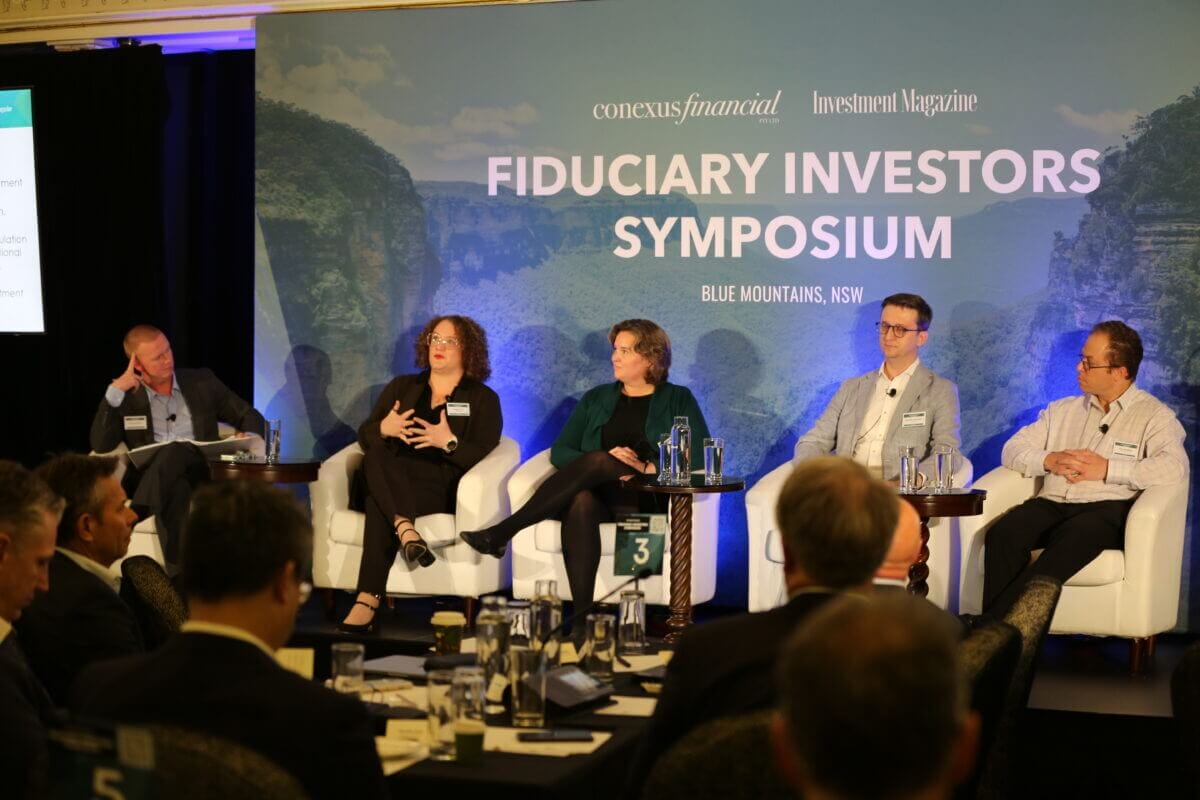
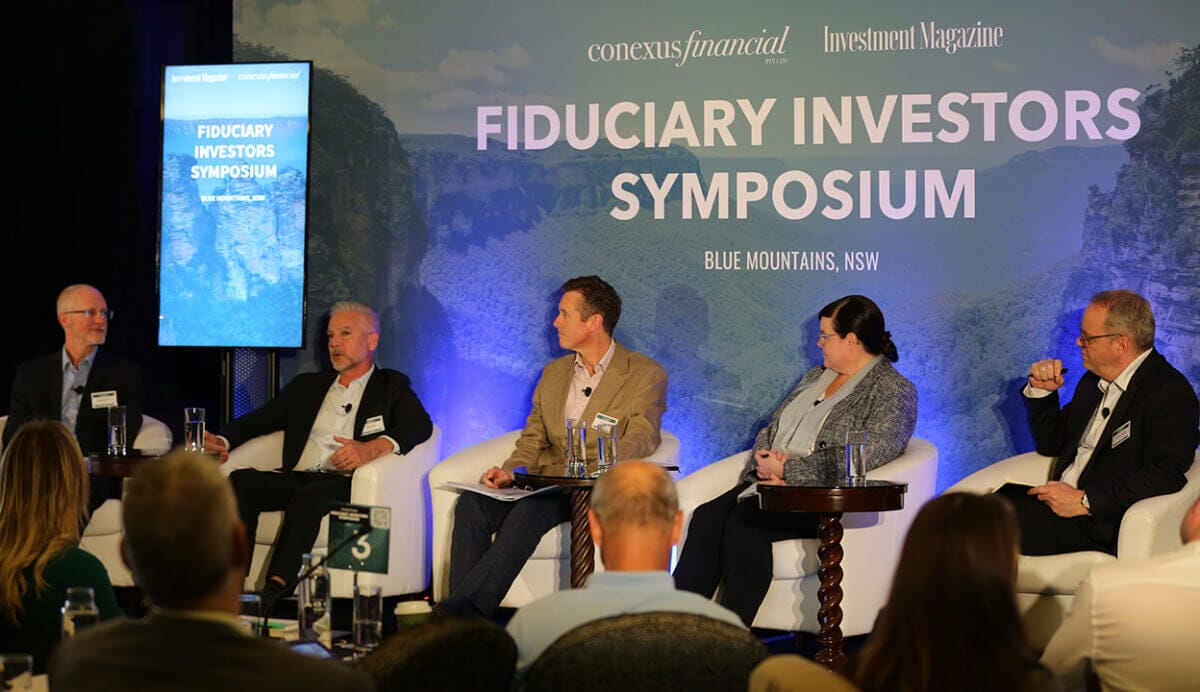
Super funds collectively are large enough and sufficiently concentrated in growth assets that a significant sell-off in the US equity market holds potential systemic risk, the Investment Magazine Fiduciary Investors Symposium has heard.
The Conexus Institute’s* research fellow, Dr Geoff Warren, told the symposium that a decade of poor market returns is plausible, with the historical record putting the probability at around 10 per cent for a balanced portfolio and higher for equities alone. A poll of attendees at the Symposium put the probability of zero or negative real returns over any 10-year period between 10 per cent and 20 per cent.
“So they’re not that rare,” Warren said. “They happen. Do not rule it out, it can happen. It has happened.
“It’s pretty sobering to think if the US return on equity mean-reverted to the average in the US, if the PE [ratio] mean-reverted to its average, the fall in the US equity market just from that is 50 per cent. It halves.
“So fine, if it continues to deliver and stays highly valued, but if, for some reason, we have an event that swings you to the other end of the scale, that is a bloody big fall in the market.”
The institute’s concern about risk is not so much an acute liquidity crisis –because liquidity stress would need to escalate through a sequence of steps before becoming a systemic crisis –
butt slower, prolonged losses, leading to reduced retirement savings for millions of members, political pressure for early release, and a collapse of confidence in superannuation as a reliable vehicle for retirement income.
Warren said there were four structural drivers that could produce extended market weakness: an protracted period of poor earnings relative to embedded expectations; a valuation adjustment from historically high starting points; a sustained high-inflation environment; and a deterioration in the supply-demand balance for equities that has been overwhelmingly positive for decades.
Warren said the most likely trigger for a reversal in demand for equities was not investors spontaneously deciding to sell equities, but economic stress forcing asset liquidation. Recent research shows that when the US equity market falls, the significant sellers tend to be wealthy private individuals liquidating because their businesses are under stress rather than investors making a considered capital reallocation.
“What that got me thinking is, if you get into a situation where there’s unemployment, or business is just doing poorly, and people need to liquidate their assets, you create this forced selling,” he said.
“That’s the thing that neutralises the buy-the-dip mentality.”
Warren said he was also concerned about how funds communicate to members when markets fall. He said a “buy the dip” message carried an implication that markets always rebound.
“What we’re trying to say is communicate that taking growth on and staying with growth is the most sensible strategy to do, but not to present it as a promise or a guarantee,” he said.
If the cause of a market decline was broad economic stress, rather than an abrupt shock, the result would be “an extended decline, but one that would be quite tortuous, [a] bear market that just punishes everybody who tries to buy the dip”.
“That that would be a different nature, as against an economic shock that people react to, in price, immediately.”
Warren said history is littered with examples of extended periods of zero or negative real returns. Inflation in the 1970s produced more than a decade of negative real returns, with a sharp dislocation in 1974 followed by a prolonged period of weakness.
The late 1990s technology boom collapse produced, after an initial fall and partial recovery, a second dip that drove negative real returns for about a decade. The S&P 500 took about 13 years to recover to its pre-crash peak in real terms. Warren said both episodes were largely driven by valuation adjustments, with markets starting from highly valued positions and then swinging to the other end of the range.
“You had the market start from a highly valued state, and something happened that went to the other end of the range to being lowly valued. And that was the main driver behind those declines, which is really interesting, because it makes you think about starting from a high valuation state, with a lot of optimism in it, you’re probably at a higher risk for this occurring.”
Warren said the system’s structure, including the performance test focus on peer-performance, made portfolio protection at the accumulation stage difficult to implement. Funds were unlikely to be able to either time a market decline or put in place permanent hedging at meaningful scale.
There was also political risk embedded in a sustained downturn. A poor economic environment, with markets down and unemployment rising, would create strong political pressure for early release of superannuation. Covid had demonstrated how this might go in practice.
“Covid was one thing – it came and it went and wasn’t a problem, but at least it broke the seal,” Warren said. “I would bet early release would be politically popular.”
The Conexus Institute’s executive director, Dr David Bell, said sustained market weakness feeds directly into liquidity risk. A Conexus Institute paper, Systemic impacts of ‘big super’ published in January 2025, traces the stages through which the system would need to pass before liquidity stress reaches system level. A full-blown crisis remains unlikely, Bell said.
Bell said the landscape had shifted since the institute’s liquidity stress framework was first developed. An ageing membership moving into the draw-down phase, combined with the movement of members nearing retirement toward financial advisers and out of the APRA-regulated fund system, represents a new and growing outflow dynamic.
He said more attention should be paid to large funds running sophisticated collateral management and committed funding arrangements that are generating significant additional return, but also introducing a set of subtle liquidity risks the framework had not previously captured.
“Is this the [unspoken] thing amongst the industry?” Bell said.
He said regulators are likely still framing performance and risk through a traditional lens of manager and security selection, which is the wrong one.
“I really want to investigate… what additional risks they do bring, because I think there has been an example or two with the Canadian funds where they have run into liquidity challenges, so I don’t think it’s a risk-free activity.”
*The Conexus Institute is a not-for-profit think-tank philanthropically funded by Conexus Financial, the publisher of Retirement Magazine.















Leave a Comment
You must be logged in to post a comment.